
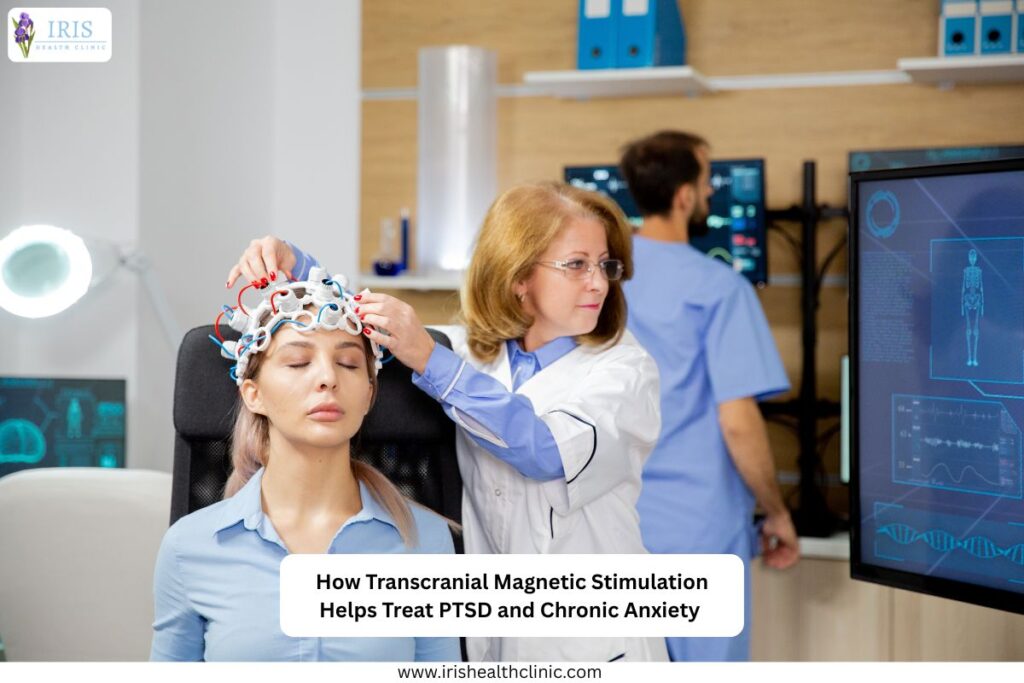
Living with PTSD or chronic anxiety may feel draining and lonely, especially when traditional therapies do not offer the relief you hope for. Many people have limited success with medication or talk therapy and ultimately feel stuck in an unwanted cycle of stress, trauma triggers, or panic. This is the place where Transcranial Magnetic Stimulation Therapy offers real opportunity for change for those who did not respond well to traditional treatments. At the Iris Health Clinic, patients have seen a consistent restoration and emotional health through this advanced TMS Therapy, making it a trusted resource for ongoing care.
What Is Transcranial Magnetic Stimulation and How Does It Work for PTSD and Anxiety?
Transcranial Magnetic Stimulation Therapy is a non-invasive, FDA Approved treatment that uses magnetic pulses to stimulate underactive parts of the brain that control mood, emotional responses and stress. When these brain circuits experience disturbance through chronic anxiety, trauma exposure, or treatment resistant depression people may become frozen in fear, have intrusive thoughts, or feel they cannot regulate their emotions or behavior. This form of TMS Therapy restores healthier functioning by re-stimulating these areas and balancing neural pathways. Here’s how it works for PTSD and anxiety:
- It stimulates the prefrontal cortex to improve mood regulation
- It dampens overactivity of the amygdala and reduces fear and trauma responses
- It improves communication between emotional processing and cognitive processing
- It helps to reduce intrusive thoughts and the emotional response to stimuli
- It helps with long-term stabilization of stress responses
- It creates healthier brainwave patterns that are associated with less chronic anxiety
- It naturally increases serotonin and dopamine activity without medication
The neurological changes that occur with TMS Therapy are the reason it has become one of the best treatment for resistant depression options and a strong benefit for people with PTSD and chronic anxiety.
How Does TMS Help People with PTSD?
The brain of a person with PTSD undergoes changes in how it stores memories, perceives threats, and reacts emotionally. In such a situation, a reminder of something very small can incite panic, flashbacks, or emotional shutdown. While medication may help some individuals, many continue to experience persistent symptoms—especially those dealing with treatment resistant depression therapy alongside PTSD.
TMS reduces hyperarousal by calming overactive brain regions connected to fear. It improves emotional regulation by strengthening communication between areas responsible for logical processing and emotional control. Individuals whose treatment includes TMS usually experience a decrease in the number of intrusive memories and an improvement in their emotional stability, as the therapy helps the brain to function in a more balanced way again. Besides, TMS makes trauma-focused psychotherapy more effective, thus counseling and EMDR therapy sessions become more productive.
At Iris Health Clinic, PTSD patients may, for instance, witness improved sleep, diminished reactivity, and increased emotional resilience. The process of change in these people makes it possible for them to regain the confidence they need and to feel that they have control over their daily life again.
How Does TMS Relieve Chronic Anxiety?
Chronic anxiety often develops when the brain becomes locked in a high-alert state, causing worry and fear-based responses even in safe environments. Chronic anxiety is frequently the aftermath of the brain being stuck in a high-alert mode for a long time, which is the reason why worry and fear arise even in situations that are actually safe. The same way as in treatment-resistant depression, a great number of people are in the position of trying several medications and therapy methods, but their symptoms keep on recurring. Transcranial Magnetic Stimulation Therapy contributes to solving this problem by the manner of silencing those parts of the brain that are too active and by bringing back the brain to normal functioning.
How TMS helps reduce chronic anxiety symptoms:
- Restores balanced and calm brainwave activity
- Reduces excessive firing in anxiety-related circuits
- Supports natural regulation of serotonin and dopamine
- Decreases physical anxiety symptoms like muscle tension and restlessness
- Improves mental clarity and reduces racing thoughts
- Offers long-term relief without dependency or sedation
- Helps retrain stress response systems for lasting stability
Is TMS Effective for Treatment-Resistant Conditions?

As a result of their genes, prolonged trauma exposure, an imbalance caused by chronic stress and years of trial and error, some people do not respond to medication. These cases eventually lead to TMS for treatment resistant depression, where keeping up with the progress seems to be impossible.
TMS, by its nature, stimulates the areas of the brain which are responsible for motivation, emotional processing, and mood regulation, resulting in considerable improvements which, in most cases, patients have never experienced with medication alone. It enhances clarity of thought, stability of mood, and supports daily functioning. Because of these results, Transcranial Magnetic Stimulation Therapy is widely recognized as one of the best treatment for resistant depression, chronic anxiety, and PTSD.
Patients who receive TMS at Iris Health Clinic often describe the therapy as transformative, mood stability, and daily functioning after years of struggle.
What Are the Major Advantages of Choosing TMS for PTSD, Anxiety, and Resistant Depression?
- Completely non-invasive and requires no anesthesia
- Safe, FDA-approved, and well-tolerated for long-term use
- Does not cause medication-related side effects such as weight gain or sedation
- Allows patients to resume daily activities immediately
- Provides long-lasting improvement for PTSD, anxiety, and treatment resistant depression therapy
- Supports stronger emotional regulation and cognitive functioning
- Enhances the results of therapy and lifestyle changes
- Effective for individuals who did not respond to medication
- Targets brain regions responsible for fear, mood, and stress regulation
- Recognized as one of the best treatment for resistant depression
How Does Iris Health Clinic Deliver TMS Differently?
Not all TMS programs deliver equal results. At Iris Health Clinic, we offer an individual treatment plan based on neuroscience, compassion, and advanced technology. With each treatment plan, a detailed assessment starts by pinpointing the exact brains regions, targeting the right areas for stimulation, delivering a dependable program.
The trauma-informed care model ensures emotional comfort and safety that is especially important for individuals who are experiencing PTSD or chronic anxiety. The team also treats treatment resistant depression, making alterations and adjustments throughout treatment to ensure that treatment continues to provide the maximum improvement. With supportive monitoring, progress tracking, and continuous guidance, patients feel understood, cared for, and empowered throughout their healing journey.
Key Takeaways
- TMS is a proven therapy for PTSD, chronic anxiety, and tms for treatment resistant depression.
- After a while the circuits in the brain that govern mood and emotional regulation are rebalanced.
- For the condition of resistant depression TMS is one of the very best treatments to be used by those who are not responding to medication.
- TMS offers long-lasting benefits with minimal side effects.
- Iris Health Clinic provides personalized and highly effective TMS programs.
FAQ’s
Q1. Is TMS safe for long-term use?
Ans: Absolutely. The US FDA has given its approval for the procedure to be a non-invasive one and safe when done repeatedly or for a long period of time.
Q2. How soon will I feel results?
Ans: Most people undergoing TMS treatment will feel an improvement in their mood and anxiety symptoms within 2–4 weeks time.
Q3. Does TMS help if medication has failed?
Ans: Yes. That is what this method is, a device for people with treatment-resistant depression and difficult anxiety who are on medication that has failed them.
Q4. Does the procedure hurt?
Ans: The majority of patient feel that there is a slight tapping on the scalp. However, there is no significant discomfort in the procedure.
Q5. Can TMS treat both depression and PTSD together?
Ans: Of course. The reason why TMS side effects are very low is that the brain areas intervened in both disorders overlap so it is possible to get both conditions improved simultaneously by TMS.
Find Hope, Healing, and Balance Through TMS Therapy
Transcranial Magnetic Stimulation Therapy is the way to go for anxious and depressed people suffering from PTSD and treatment-resistant depression. The therapy is painless, has a lasting effect, and is supported by strong scientific evidence, which makes it one of the prominent modern mental health treatments available. Iris Health Clinic is the place for you if you are looking for the best treatment for resistant depression or long-term relief from PTSD and anxiety. We would love to hear from you if you want to learn more or simply want to schedule a consultation with us today.