
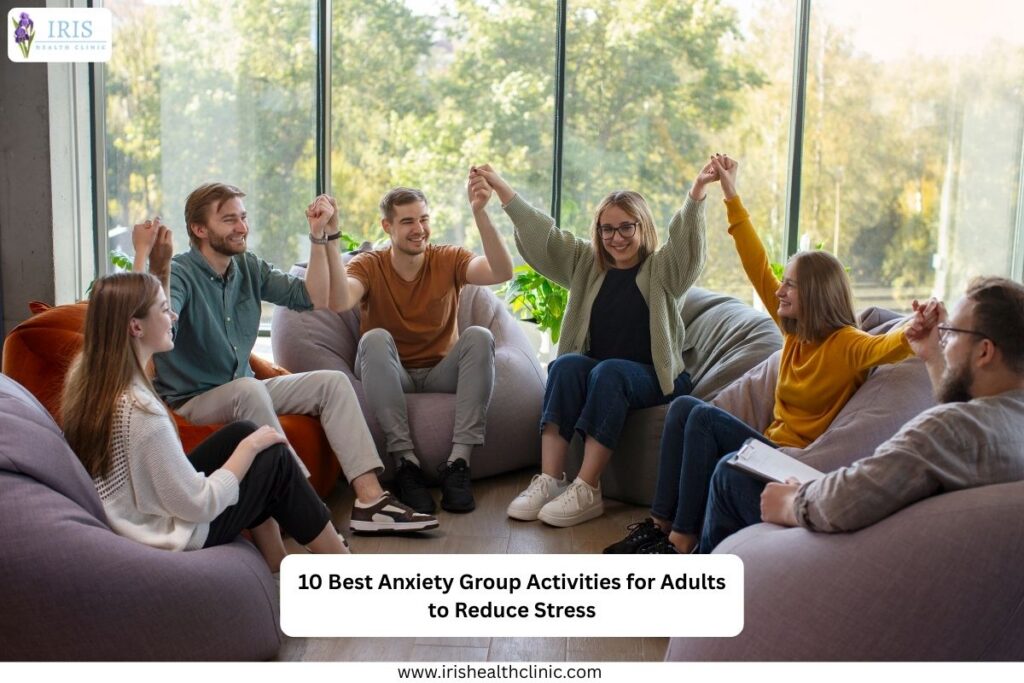
Anxiety can be extremely difficult and frustrating, more so if it is limiting your work, relationship, and general day, to, day functioning. At Iris Health Clinic, we have witnessed how structured group, based interventions open up wonderful opportunities for healing. Anxiety group activities for adults give a chance for the development of skills and emotional support among the participants through interaction and in a safe and guided environment.
Whether an individual is in group therapy for anxiety and depression, therapy for social anxiety, or addiction group therapy, structured activities are a great way to lessen the stress levels and result in improved outcomes in the long run.
Here are anxiety group activities to succeed with stressed adult participants:
1. Guided Mindfulness Meditation
The Mindfulness tasks require participants to concentrate their attention on the present moment while they practice non-evaluative observation skills. The practice of group breathing exercises together with body awareness training enables participants to achieve muscle relaxation while their mind activity decreases.
This group therapy program serves as an appropriate treatment for people who experience generalized anxiety disorder and stress-related disorders and depression.
2. Cognitive Restructuring Exercises
The Cognitive Behavioral Therapy framework provides this task which enables members to identify their destructive thinking patterns and replace them with balanced realistic thoughts. Participants work on changing anxious thinking patterns in groups.
Best for: Group therapy for anxiety and depression.
3. Social Exposure Role, Playing
Socially, exposure, oriented therapy uses role play regularly to develop social skills through practice of chats, speech, and social events. It is also used for treatment of social phobia. It allows the client to gain confidence and demonstrate newly learned skills.
4. Stress Mapping and Trigger Identification
The group members explain their personal anxiety triggers while they demonstrate their problem-solving techniques. When people share their experiences, they no longer feel alone and are able to learn from their peers.
Best for: Adults who participate in outpatient treatment or organized mental health programs.
5. Progressive Muscle Relaxation (PMR)
The technique produces a reduction in muscular tightness and headaches and restlessness. The resulting good state of physical health shows itself through milder symptoms which include muscular tightness and headaches and restlessness.

6. Journaling and Emotional Processing
Through writing, clients can face their deepest fears while they learn to identify their emotional responses. The group discussion provides everyone with confirmation which helps to build shared understanding among the group.
Helpful in: Group therapy for depression and anxiety, focused programs.
7. Grounding Techniques Practice
The 5 4 3 2 1 sensory method serves as a basic example. The method enables adults to stay present during panic attacks and high-stress emotional situations.
8. Peer Support Circles
People who participate freely share their struggles and successes on a weekly basis. Through this, they develop a sense of responsibility and their relationship gets stronger. Both are necessary components of a therapy addiction group or a dual diagnosis group treatment.
9. Behavioral Activation Planning
This is one of the activities that are often used in programs for depression. Here, the individual is encouraged to plan activities that are meaningful or can elevate the mood. In the case of group therapy for social anxiety and depression, this is very effective because these disorders often result in people avoiding their problems.
10. Values Clarification Exercises
Participants set their values and goals for the future. This act of recognition will help the individuals to stop doing things out of fear and instead follow through their actions based on their values.
Why Anxiety Group Activities Work
Studies show that structured group therapy sessions allow:
- Reduced feelings of isolation
- Increased accountability
- Improved coping skill development
- Enhanced emotional regulation
- Stronger peer support systems
At Iris Health Clinic, we customize treatments based on scientific evidence and the individual’s needs.
How Iris Health Clinic Supports Adults with Anxiety
We provide complete mental health services which include the following:
- Group therapy for anxiety and depression
- Therapy for social anxiety
- Addiction group therapy
- Integrated support for co-occurring conditions
Our licensed clinicians create a structured, supportive environment which enables adults to acquire effective methods for permanent stress relief.
Frequently Asked Questions (FAQs)
1. Are group activities for anxiety beneficial for adults?
Yes. Group activities that are structured teach individuals how to deal with difficulties while they work on their ability to manage their emotions and reduce feelings of loneliness. Many adults find that they reduce their stress levels.
2. In what way is group therapy for anxiety and depression different from individual therapy?
Group therapy enables people to interact with other participants while they study and fulfill their program requirements, whereas individual therapy delivers customized treatment. Both can be highly effective together.
3. Can anxiety group activities help with social anxiety?
Absolutely. Social anxiety treatment typically uses role-playing exercises together with exposure drills and communication training that occurs inside a secure group setting.
4. Is addiction group therapy helpful for people with anxiety?
Yes. People who experience addiction problems typically develop anxiety disorders. Group therapy for addiction deals with addiction as well as emotional issues.
5. How long does it take to see results from group therapy?
Some people see results in a short period of time. Others need more time to finish their treatment because their requirements and objectives differ from other patients.
Take the First Step Toward Stress Relief
People who experience anxiety in their lives can achieve recovery through organized group activities and expert support.
The Iris Health Clinic provides compassionate evidence-based treatment to help you and your loved ones develop skills for permanent emotional recovery.